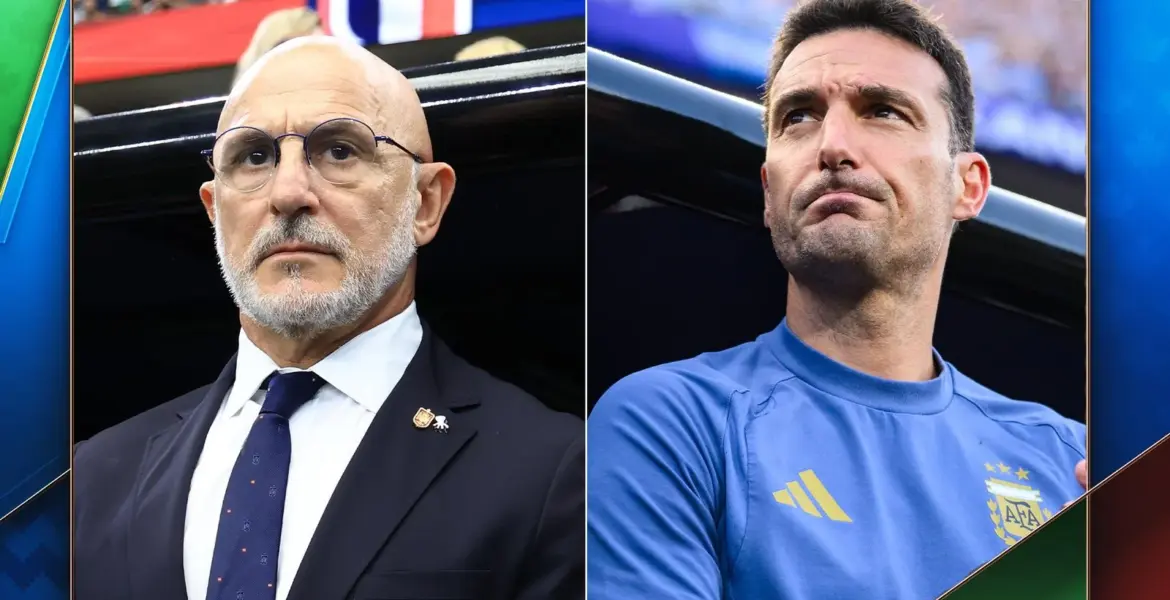

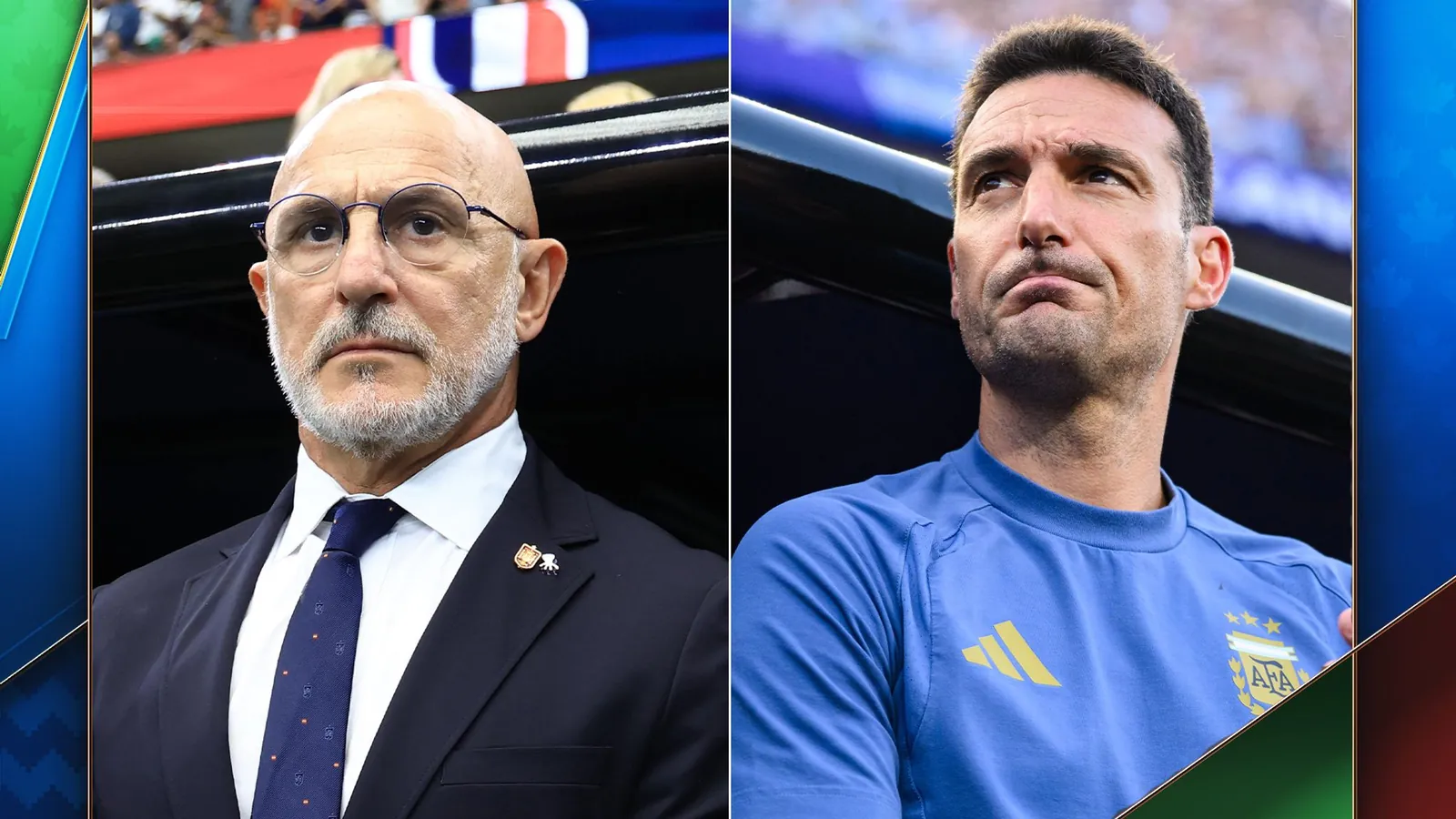
The upcoming World Cup final will feature a clash between Spain and Argentina, led by managers Luis de la Fuente and Lionel Scaloni, respectively. Both coaches have achieved significant success with their national teams despite not having managed top-flight club games. Their approaches to team building and tactical flexibility have been highlighted as key to their teams’ performances.
Lionel Scaloni took over Argentina when the team had not won a major tournament in 25 years. Since then, he has guided them to three consecutive major international trophies, including the last World Cup and the Copa America. His tenure began as an assistant to Jorge Sampaoli in 2018 before he assumed the top role. Scaloni’s ability to adapt tactics and foster a strong collective spirit within the squad has been noted by players.
Luis de la Fuente, who was promoted from Spain‘s U21 team, has also seen considerable success. He led Spain to a Nations League victory just six months after replacing Luis Enrique in 2023. De la Fuente’s long history with many of the national team players, having coached them at the U19 and U21 levels for a decade, has helped him build a cohesive unit. His emphasis on a ‘family’ atmosphere within the team is a cornerstone of his management style.
The contrasting styles of play between Spain and Argentina are expected to make for an intriguing final. Spain is known for its possession-based game, with midfielder Rodri central to controlling the tempo. Argentina, conversely, is described as a passionate and aggressive team, often prioritising physical play to disrupt opponents’ rhythm, a tactic observed in their semifinal against England.
The semifinal saw Argentina secure its place in the final after a late comeback against England. Lionel Messi was a decisive factor in that match, contributing two assists. This performance moved him ahead of Kylian Mbappé as the tournament’s leading scorer, with both players having scored eight goals. Messi‘s ability to make a difference for his team is a significant aspect of Argentina‘s strategy.
The success of Scaloni and De la Fuente stands in contrast to the performances of some higher-profile managers in the tournament. Thomas Tuchel, who managed England, faced criticism following their semifinal elimination. Similarly, Julian Nagelsmann‘s Germany exited in the round of 32, and Carlo Ancelotti‘s Brazil did not advance past the last 16. These outcomes have prompted discussions about what constitutes effective international management.
Both Scaloni and De la Fuente were initially met with scepticism when appointed. However, their focus on fostering trust and strong relationships with their players has been instrumental in their achievements. De la Fuente‘s players, including captain Rodri, have highlighted his leadership in uniting the team. Similarly, Nicolas Otamendi and Emi Martinez have praised Scaloni‘s man-management skills and his ability to treat all players equally.
Tactical acumen is another shared trait between the two finalists’ coaches. Scaloni is recognised for his tactical flexibility and his capacity to adapt to different game situations and opponents. Argentina‘s varied approach, whether defending deeply, dominating possession, or playing on the counter-attack, has been a hallmark of his tenure. De la Fuente also demonstrated his tactical expertise in Spain‘s semifinal, where his team’s out-of-possession setup effectively neutralised the opposing attack.
A notable incident during Argentina‘s semifinal celebrations involved players unfurling a banner that read: “LAS MALVINAS SON ARGENTINAS” (The Malvinas (The Falklands) are Argentine). Midfielder Giovani Lo Celso and center-back Lisandro Martínez were seen holding the banner. This political message refers to the British-ruled Falkland Islands, a long-standing point of contention between the United Kingdom and Argentina. FIFA‘s Stadium Code of Conduct prohibits banners of a political, offensive, or discriminatory nature, and Law 4 of the Laws of the Game also bans political messaging. The UK Business Secretary Peter Kyle described the banner as “entirely inappropriate” and stated an expectation for FIFA to conduct an investigation. Previous instances of political banners have led to sanctions, such as South Korea‘s Park Jong-woo receiving a two-match international ban in 2012 and Spain‘s Rodri and Álvaro Morata being banned for one match by UEFA in 2024.
The final match is scheduled for Sunday.
Read Also
Source: cnn.com
You may also like

Joel Kavanagh is a Sports News Writer at News-GB. He started on a Midlands sports desk. He focuses on rugby union, golf and boxing and is known for clear, deadline-driven reporting. He holds a degree in Journalism from De Montfort University and completed an NCTJ diploma. Now based in Leicester, he plays amateur rugby and follows the fight calendar. “In sport news, the first ten minutes decide everything.”